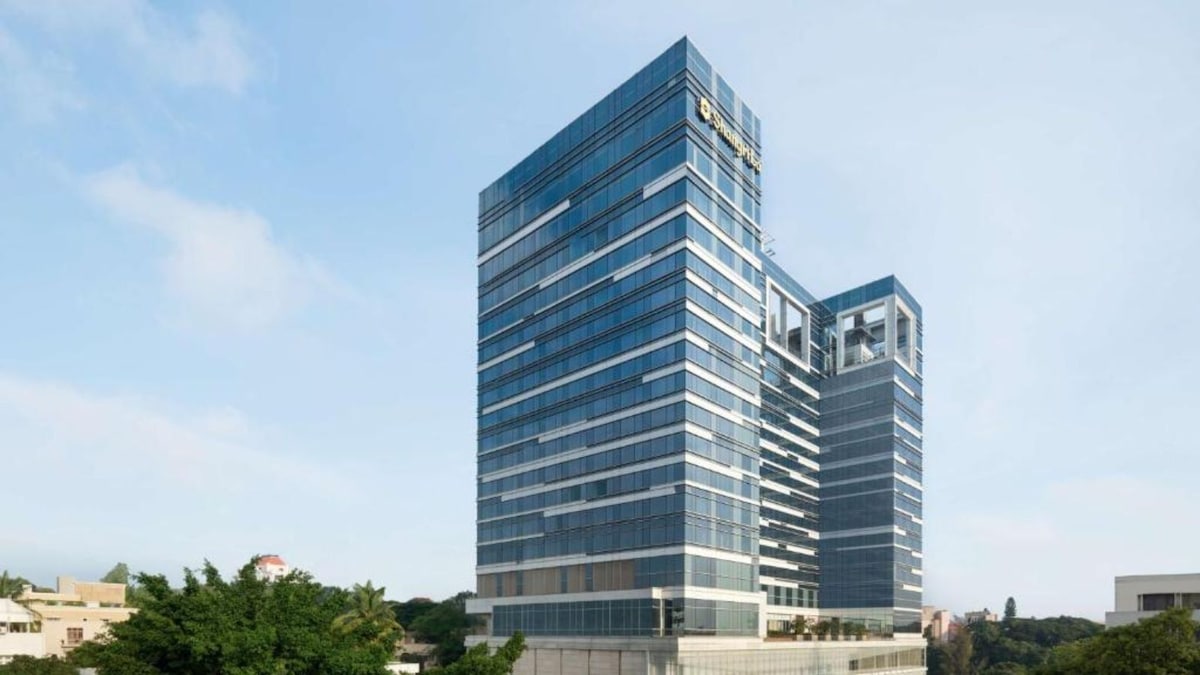
Shangri-La Bengaluru Exits; ARTEZIA Inherits 397 Keys
Alekhya Property Developments assumes full ownership and identity of the de-flagged luxury hotel, triggering complete architectural and material infrastructure redesign.
Shangri-La Hotels has de-flagged its Bengaluru property after years of management. Alekhya Property Developments now owns the 397-key asset outright and has renamed it ARTEZIA—a direct statement that the property's identity and operational infrastructure belong to the owner alone. This shift from managed brand to owned brand carries immediate consequences for every touchpoint: signage, wayfinding, guest collateral, staff uniforms, room furnishings, dining environments, and the entire sensory apparatus that guests and stakeholders encounter.
For Single Family Offices and heritage operators, this de-flagging presents a reading of market conditions worth noting. International hotel brands increasingly face pressure on margins and operational control. When an owner moves to full autonomy, it signals confidence in local market demand and the operator's ability to manufacture premium experience without relying on a global brand apparatus. The financial implication is direct: margin retention stays with the property. The identity implication is equally sharp: everything that carries the ARTEZIA name must be engineered from first principle.
What the move signals about ownership strategy
De-flagging a 397-key luxury property is not a retreat. It is a repositioning. Alekhya Properties retains all operational sophistication—housekeeping standards, revenue management, culinary talent—but displaces the cost and constraint of brand royalties and global standards. Under Shangri-La, the property was bound to corporate guidelines for everything from lobby finishes to guest amenity packaging. As ARTEZIA, the owner manufactures its own standards.
This is particularly significant in the Bengaluru market, where ultra-high-net-worth clientele and corporate headquarters create distinct demand patterns. A proprietary brand can move faster on pricing, design iteration, and service customization than a global franchise. The owner keeps the margin delta and controls the narrative entirely. For principals evaluating ownership positions in gateway markets, this exemplifies the economics of autonomous operation.
Where the branded identity layer requires infrastructure
The physical rebrand touches everything that carries a guest's eye or hand. The entry canopy. The key card system. The room slate, linens, glassware. The staff livery. Wayfinding throughout public spaces and corridors. Event signage and collateral. The dining program's menus, coasters, server uniforms. Parking passes. The luggage tag system. Guest amenities—from bath products to notepads. The hotel's external signage, building wraps, and directional markers.
Each of these categories requires decisions: material selection, production vendors, delivery timeline, installation coordination, and brand guideline documentation. A single-property owner has no buying power to amortize design across multiple locations. Every selection must be economically defensible for one property. This is where experienced operators often err—they underestimate the cost and lead time of manufacturing complete branded identity infrastructure for a property of this scale. A 397-key hotel operates with perhaps 40-50 distinct categories of branded objects and environments. Each requires specification, sampling, approval, and installation during a soft-opening window that cannot exceed 90 days without revenue impact.
What operators do now, in the window
The opportunity exists from de-flag announcement through full rebranding. During this window, an experienced operator: audits all existing branded assets and establishes what can be retained (architectural elements, certain operational systems); specifies new brand guidelines with discipline and restraint (a common error is over-designing); sources production vendors for the highest-velocity categories (signage, key systems, staff uniforms, guest room elements) in parallel, not sequence; and keeps a single brand arbiter for all approvals to prevent scope creep and timeline slippage.
The window typically spans 60-120 days. Cost for complete rebrand infrastructure at this scale runs $800K–$2.2M depending on finish standards and material choices. The principal's Chief of Staff should note that timeline is more constrained than budget. A delayed signage order or textile shipment cascades into reopening delays that cost far more than the infrastructure itself.
This is how the house handles it: specification, coordination, vendor auditing, and timeline governance. The work is disciplined and structured, never hurried.
Editorial & Disclosure Notice: This article was written with artificial intelligence from public sources and is published without individual human review. Artificial intelligence and other digital tools are also used for research, analysis, editing, formatting, and production. Errors, omissions, outdated information, or inaccuracies may occur. References to companies, brands, products, services, organizations, or individuals are for informational and editorial purposes and do not imply endorsement, sponsorship, affiliation, partnership, or approval unless expressly stated. All trademarks and other intellectual property remain the property of their respective owners. Opinions, analysis, estimates, and commentary are informational only and should not be construed as financial, investment, legal, tax, medical, procurement, or other professional advice. Information may be corrected, clarified, or updated after publication. Corrections or removal requests: jenny@pops4.com.