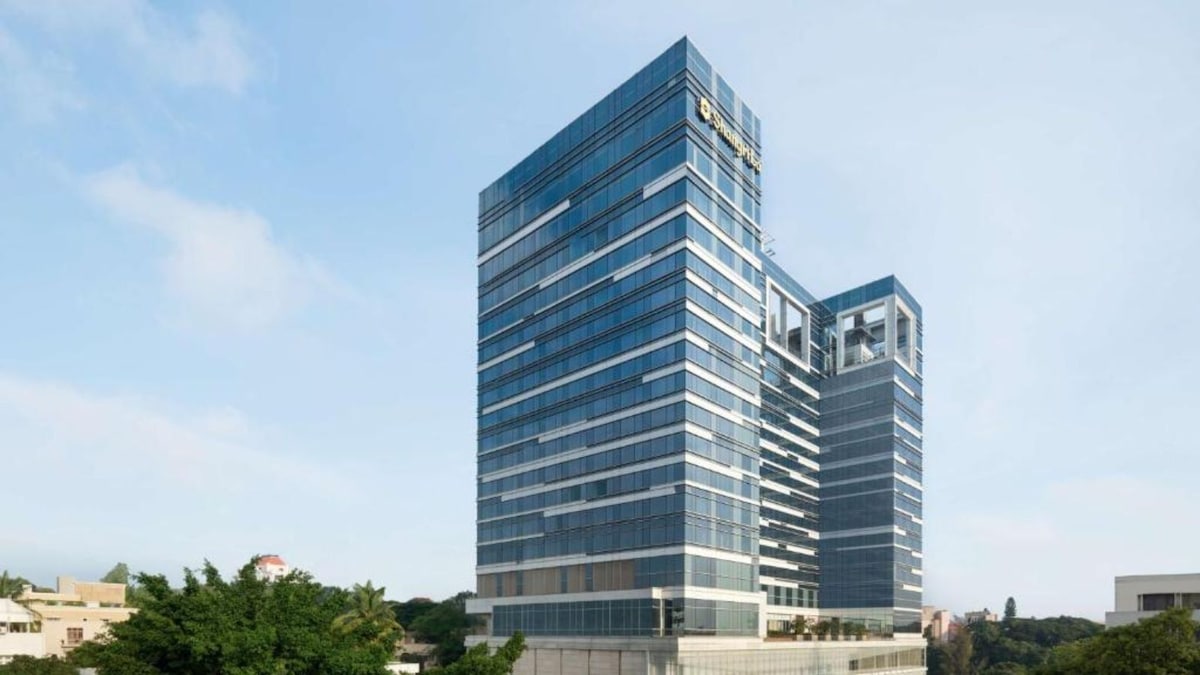
Alekhya Exits Shangri-La Flag. Identity Layer Requires Rebuild.
A 397-key Palace Road property moves to independent ownership, triggering full collateral refresh, guest object strategy, and packaging architecture.
Alekhya Property Developments has de-flagged its 397-key luxury hotel on Palace Road, ending its Shangri-La agreement and moving the asset under direct ownership and operation. The move signals a deliberate shift toward proprietary brand control—a decision that redistributes identity weight from a global flag to a house mark that must now carry all the operational and perceptual load.
This is not a cosmetic change. When a property exits a legacy system, every touchpoint that carried the flag's architecture must be rebuilt: key packets, amenity packaging, in-room collateral, directional signage, dining menus, staff uniforms, arrival sequences. The property's physical identity and guest encounter chain require systematic reconstruction.
What the Move Signals
De-flagging at this scale reflects operator confidence in the property's asset quality and local market position. Alekhya has determined that retaining flag association costs more than independence gains. The trade-off assumes the house mark, ARTEZIA, carries enough operational competence and market recognition to sustain rate position and occupancy without external validation.
This move also signals a shift in identity strategy. Independent operators often move faster on design decisions, guest programming, and seasonal collateral refresh. They avoid flag dilution and flag lag—the time between corporate directive and property execution. That operational velocity requires a fully articulated branded identity infrastructure from day one. Halfway measures produce guest friction.
Where the Identity Layer Breaks
The critical vulnerability sits in transition window. A property cannot run dual identities. Flag assets must be removed, replaced, or retired within weeks, not months. That compressed timeline demands pre-built collateral architecture: guest objects, packaging systems, wayfinding standards, amenity suites, and imprinted hard goods that can deploy without delay.
Many operators underestimate the scope. A 397-key property requires hundreds of touchpoint decisions across arrival, room, dining, public space, and departure. Each surface, object, and moment must reinforce ARTEZIA's positioning. Gaps create ambiguity. Ambiguity erodes brand perception and guest confidence.
What Operators Do in This Window
Experienced operators move immediately on three fronts. First: lock brand standards and design language—the visual and material code that makes ARTEZIA recognizable and defensible. Second: build the collateral and object suite—everything from key cards to luggage tags to departure packaging—so nothing carries the old flag on opening day. Third: imprint staff knowledge and service protocols into the new identity so the guest encounter reflects intentional house values, not inherited flag systems.
The time to source, produce, and imprint these elements is narrow. Three to six months is typical. That timeline eliminates generic work and off-shelf compromise. It requires a partner who understands hospitality identity architecture and can move at operator speed.
Alekhya has a property-level asset that now requires a proprietary identity strong enough to compete independently in a market that once trusted a global flag. The way this gets handled—the coherence of the visual code, the consistency of the branded objects, the discipline of the guest object story—will determine whether ARTEZIA reads as a deliberate house or a flag exit in progress.
Editorial & Disclosure Notice: This article was written with artificial intelligence from public sources and is published without individual human review. Artificial intelligence and other digital tools are also used for research, analysis, editing, formatting, and production. Errors, omissions, outdated information, or inaccuracies may occur. References to companies, brands, products, services, organizations, or individuals are for informational and editorial purposes and do not imply endorsement, sponsorship, affiliation, partnership, or approval unless expressly stated. All trademarks and other intellectual property remain the property of their respective owners. Opinions, analysis, estimates, and commentary are informational only and should not be construed as financial, investment, legal, tax, medical, procurement, or other professional advice. Information may be corrected, clarified, or updated after publication. Corrections or removal requests: jenny@pops4.com.