Bosch Routes Identity Through 100-Year Landmark
Automotive aftermarket division anchors windshield wiper launch to Route 66 centennial, signaling how heritage brands manufacture consumer presence at scale.
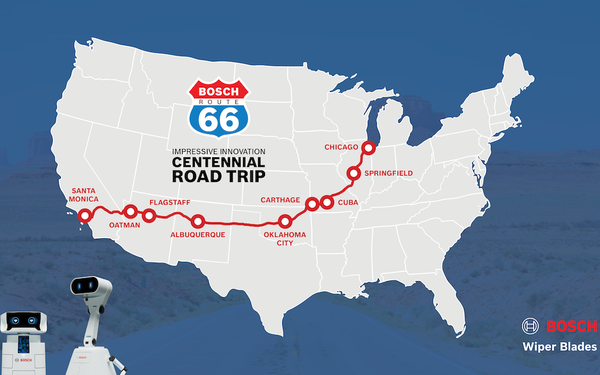
Bosch's automotive aftermarket division has launched a Route 66 100th Anniversary activation—a full-scale experiential campaign designed to move a new windshield wiper product line into consumer hands across the United States. The campaign imprints Bosch identity onto physical touchpoints at scale: branded packaging, collateral, and field objects distributed through Route 66 corridor engagement events, retail partnerships, and direct consumer activation. What this represents is not marketing outreach. It is infrastructure.
Where heritage infrastructure meets commerce
Route 66 carries structural weight in American automotive culture. The road itself is artifact. Bosch's decision to anchor a product launch to its centennial is a calculation: tie new inventory to proven cultural gravity, then manufacture consumer engagement by making Bosch the imprint on that story. This requires more than messaging. It requires objects in hands, packaging that holds, collateral that stays. The campaign moves Bosch from brand-as-storyteller to brand-as-artifact-keeper. That distinction matters for operations. Heritage roads, heritage brands, heritage-house operations all move the same way: they keep physical presence first, narrative second.
What this signals for branded identity infrastructure
A campaign of this scale—consumer engagement at Route 66 scale—succeeds only if every object imprinted with Bosch identity performs the same function: it moves the product story, keeps the brand in hand, and displaces competitor presence. Packaging alone does not achieve this. Collateral alone does not. Field activation objects alone do not. They must work as a system. What Bosch has triggered is a branded identity infrastructure play. The windshield wiper is the product. The Route 66 activation is the story. But the infrastructure—the system of imprinted objects, packaging hierarchy, collateral sequencing, field logistics—is the real operation. This is where most brands break. They design beautiful objects and distribute them. They do not design systems that keep working after the event closes.
The procurement and operations window
For operators at the VP Premium Sales and event-planning tier, this activation signals a specific opportunity window. Route 66 corridor events run from now through the centennial year. Bosch has committed to consumer engagement. What experienced operators note: first, the brand requires a procurement infrastructure that manufactures consistency across geographies and touchpoints. Second, every object must be specified to withstand handling, shipping, and the variable conditions of roadside engagement. Third, the collateral sequence—what a consumer sees first, second, third—is operational, not creative. Fourth, heritage-house CMOs understand that Route 66 events attract affluent, brand-conscious consumers who keep objects. The packaging and collateral will be kept. Design for that. Finally, this activation runs long. Seasonal activation windows mean procurement happens now. The window to imprint this infrastructure closes fast.
How the identity layer holds
Bosch moves a product. The infrastructure keeps the brand. The way this gets handled—the way Huang Goodman approaches branded identity work at this scale—starts with procurement specification, not design. What objects must imprint Bosch. Where they must work. How they must be handled. Then: the design follows the specification. Then: the field operation follows the design. Most houses reverse this. They design first, then try to specify. Infrastructure fails. Bosch has opened a window. Operators who understand infrastructure win.
Editorial & Disclosure Notice: This article was written with artificial intelligence from public sources and is published without individual human review. Artificial intelligence and other digital tools are also used for research, analysis, editing, formatting, and production. Errors, omissions, outdated information, or inaccuracies may occur. References to companies, brands, products, services, organizations, or individuals are for informational and editorial purposes and do not imply endorsement, sponsorship, affiliation, partnership, or approval unless expressly stated. All trademarks and other intellectual property remain the property of their respective owners. Opinions, analysis, estimates, and commentary are informational only and should not be construed as financial, investment, legal, tax, medical, procurement, or other professional advice. Information may be corrected, clarified, or updated after publication. Corrections or removal requests: jenny@pops4.com.