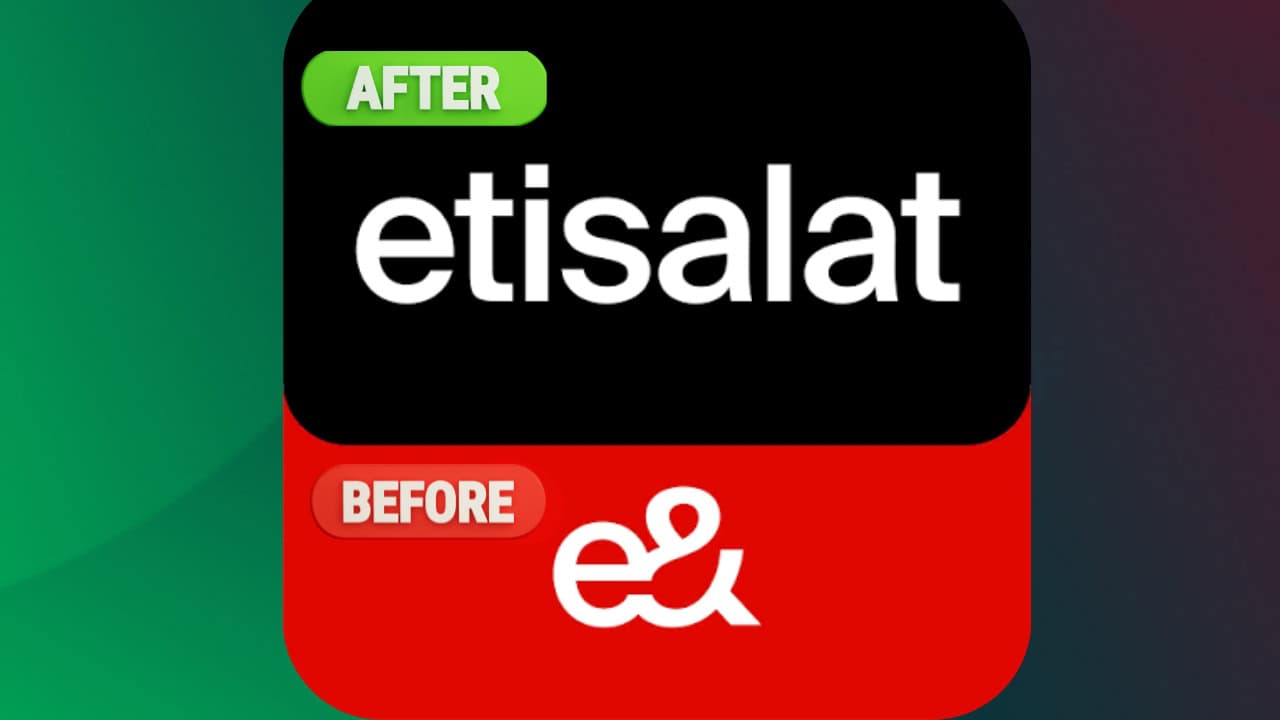
The UAE telecom operator's reversion to its founding identity demands coordinated redesign across enterprise collateral, customer touchpoints, and stakeholder materials within a compressed timeline.
Published October 21, 2026Source TechJuiceFrom the chopped neck
The UAE telecom operator's reversion to its founding identity demands coordinated redesign across enterprise collateral, customer touchpoints, and stakeholder materials within a compressed timeline.
Etisalat—the Emirates Telecommunications Corporation—has concluded its seven-year experiment with the e& corporate brand and returned to the name that built the company's regional authority since 1976. This move reverses a 2017 rebrand intended to position the operator as a diversified conglomerate rather than a telecom-only entity. The decision signals a retreat from that positioning and a return to clarity. For a company managing relationships across government entities, enterprise accounts, and premium consumer segments across the Middle East, North Africa, and South Asia, this reversion requires systematic redesign of every imprinted surface: letterhead, packaging, signage, digital infrastructure, event collateral, and the materials that travel into boardrooms and VIP presentations.
The rebranding window typically spans 18-36 months, though compressed schedules are common when reverting to a known identity. Etisalat's challenge differs from a startup brand launch. They must retire years of e& touchpoints while restoring Etisalat recognition among stakeholders who may have engaged primarily under the newer mark. This creates dual-layer complexity: inventory management (what gets replaced versus refreshed), stakeholder communication (why the move happened), and timing (which collateral classes take priority in rollout).
What the move signals for identity infrastructure
Brand reversion rarely occurs without structural reasoning. Etisalat's return to its founding identity suggests the company determined that diversification narrative underperformed against the equity built into the original brand name. For a regional telecom holding stakes in energy, fintech, and infrastructure, the e& umbrella was meant to signal ambition beyond voice and data. That it didn't stick indicates market preference for clarity over positioning. The signaling implications matter for branded identity infrastructure: established names carry weight that abstract designations do not. Etisalat means something specific to government procurement teams, institutional investors, and regional enterprises. That semantic weight justifies the rebranding investment.
Physically, this means Etisalat must produce new corporate materials across every tier: executive stationery, conference collateral, customer onboarding packages, retail signage, and the house-imprinted objects that move through premium sales channels—branded portfolios, premium gifts for enterprise stakeholders, event materials at the $250K tier and above. The color palette, typography, and visual system shift. Photography direction may require adjustment. Website architecture, app interfaces, and digital asset libraries need redesign. For a company operating across multiple countries, this work must coordinate across regional teams while maintaining consistent execution.
Where the rebranding window creates operator opportunity
Experienced operators in premium sales and event planning recognize rebranding cycles as procurement inflection points. When a company undergoes identity redesign, budgets unlock. Stakeholder events require new collateral. Enterprise packages need refreshing. VIP materials must reflect updated brand standards. The window between announcement and full rollout—typically 12-24 months—creates defined demand for branded identity infrastructure at scale.
Operators who move first establish themselves as vendors of record. This means submitting capabilities decks to Etisalat's procurement teams now, positioning your house as capable of executing large-scale, coordinated production runs across geographies. It means understanding what Etisalat's stakeholder tiers require (board-level presentation materials differ from customer acquisition collateral). It means timing proposals to the company's internal rollout phases: phase one might prioritize enterprise and government-facing materials; phase two addresses consumer-facing collateral. Operators who coordinate with Etisalat's project leadership during the announcement phase secure position ahead of competitors responding to later RFPs.
For Single Family Office principals and their Chiefs of Staff overseeing corporate identity, reversion to a known brand provides an opportunity to audit your own materials and collateral standards. If your house engages with Etisalat or similar regional players, this timing allows you to refresh materials to reflect their updated brand standards—positioning your organization as attentive and current.
The way this gets handled separates operations that understand branded identity infrastructure from those treating rebranding as a communications problem alone. Etisalat's move requires production partners who can execute at regional scale, manage inventory transitions, and deliver collateral that reflects the precision and authority the restored Etisalat name demands.
Questions buyers ask
What is brand reversion and why do companies do it
Brand reversion occurs when a company returns to a previous name or identity after adopting a new one. Companies revert when the new brand underperforms strategically or fails to resonate with core stakeholders. Etisalat's return signals the e& designation didn't establish the diversification narrative intended. Reversion leverages existing equity in the original name.
How long does a telecom rebrand usually take to complete
Large-scale rebrand timelines typically span 18-36 months for a company operating across multiple countries and customer segments. Reversion projects often compress to 12-24 months since the brand identity already exists and is recognized. Etisalat's timeline depends on complexity: government relations, enterprise account coordination, and retail rollout require phased execution.
What branded materials need updating in a corporate rebrand
Rebranding requires updates across stationery, packaging, signage, digital properties, event collateral, and house-imprinted objects used in sales and stakeholder engagement. For regional operators like Etisalat, this includes executive presentation materials, customer onboarding packages, premium gifts for enterprise accounts, and collateral at multiple tiers.
Editorial & Disclosure Notice: This article was written with artificial intelligence from public sources and is published without individual human review. Artificial intelligence and other digital tools are also used for research, analysis, editing, formatting, and production. Errors, omissions, outdated information, or inaccuracies may occur. References to companies, brands, products, services, organizations, or individuals are for informational and editorial purposes and do not imply endorsement, sponsorship, affiliation, partnership, or approval unless expressly stated. All trademarks and other intellectual property remain the property of their respective owners. Opinions, analysis, estimates, and commentary are informational only and should not be construed as financial, investment, legal, tax, medical, procurement, or other professional advice. Information may be corrected, clarified, or updated after publication. Corrections or removal requests: jenny@pops4.com.
TikTok / Reels hook
"A regional telecom giant just reversed seven years of rebranding. Every piece of their corporate identity changes. Supply chain impact starts now."
LinkedIn post
Etisalat has returned to its founding brand identity after seven years under e&. This reversion requires systematic redesign across enterprise collateral, customer touchpoints, and stakeholder materials across multiple geographies. For operators managing premium sales and event infrastructure: when established companies rebrand, procurement cycles unlock. Are you positioned to move first.
The branded-identity layer Chiefs of Staff and heritage CMOs route through — your name imprinted on real authorized stock, your pick of 200+ brands and 70,000 products, shipped from one accountable house. Nine editorial desks publish the intelligence those operators read before they sign.
200+authorized brands
70,000products · virtual proof on each
9 deskspublishing daily
1997one house, since
70,000 SKUs · virtual proof in 60 seconds · no platform fee · blind-shipped · ASI #217876
Your next customer won't visit your website. Their AI will.
AI assistants have quietly taken over the first step of buying — they answer from catalogs they can read and shortlist whoever can actually ship. Two questions now decide whether you exist to that buyer: can a machine read your catalog, and can you fulfill the order. Most brands fail one or both and never find out why the orders went elsewhere. The winners of this shift aren't the loudest. They're the most readable. Build for the machine that's about to do the shopping.
Built by the craft floor — apparel, media, packaging, and secure print.
This trade runs on hands, not desks. Imprint manufacturing & Komori heritage press through approved vendors · Canon high-speed secure-media operations is a craft floor — genuine Six Sigma discipline applied to ink, thread, foil, and registration, where a hundredth of an inch is the difference between a brand that reads serious and one that reads cheap. POPS4 is built by exactly those operators: independent, boots-on-the-ground engineers who carry their own book, read a client in microseconds, and put their name on every run. Beyond our own Virginia Beach floor, we work with a vetted network of craft manufacturers across the US — each meeting the highest excellence in QC standards in the industry, each a specialist in its own discipline — so apparel, hard-goods imprinting, media manufacturing, packaging, and secure printing all go to the bench built for them, coordinated from one accountable hub. Short-run from twenty-five units, volume to five hundred thousand. Two hundred authorized national brands, seventy thousand SKUs with virtual proofing on every one. Art archived for instant reorders. Net-thirty corporate terms, NDA-standard white-label — your name on the work, or none at all.
Strategy, positioning, identity, creative, and messaging — wired into an AI system that publishes and distributes on its own. Nine editorial desks generate the authority, the production house ships the physical proof, and the attribution layer tells you which post sold which SKU. What you get is an operating layer — content, catalog, and order path under one roof — that keeps working whether or not you are in the room. Built for principals who would rather own the machine than rent the agency.
Named-account programs — one desk, quiet delivery, NDA-standard.
One point of contact who already knows the file, so nothing restarts from zero between engagements. The work ships blind, under NDA, with your name on it or none at all. Built for single-family offices, heritage-house CMOs, sports-ownership groups, and the agencies that white-label our production. The relationship is the product; the merch is the proof of it.
SFO · Chief of Staff desk. Principal household, properties, aircraft, yacht, calendar, philanthropy — one file.
Shop seventy thousand products. Virtual proof on every one. 24/7.
Drop your logo on any product and see the virtual proof before asking. Quote routes direct to the desk. MCP catalog for AI agents. Celeste for the fast conversation. Full self-service checkout in development.