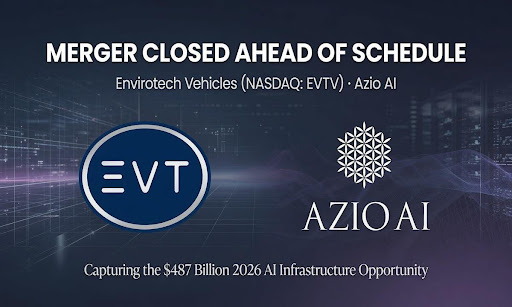
Envirotech Vehicles Closes Azio AI Merger, Pivots to GPU Infrastructure
Early completion signals rapid repositioning toward $487B data center market, requiring immediate branded identity infrastructure overhaul.
Envirotech Vehicles closed its merger with Azio AI ahead of schedule, displacing its automotive heritage entirely. The company now operates as an AI infrastructure firm targeting GPU compute and data center operations across a $487B addressable market. This is not a pivot. This is a structural reset. The speed of execution—closing early—means institutional investors, enterprise clients, and capital allocators are already asking who this company is, what it manufactures, and why they should commit capital to it. That gap between operational reality and market perception is where branded identity infrastructure either holds ground or collapses.
What the Merger Signals for Physical Presence
When a $10B+ public company discards one sector identity and imprints another in months, its physical collateral becomes obsolete faster than most boards admit. Investor decks, client presentations, trade show infrastructure, facility signage, executive briefing materials, and the objects kept in boardrooms all still reference the old company. Vendors, partners, and institutional buyers have no current materials to distribute. This creates operational friction: sales teams present on outdated slides while enterprise procurement teams search for current positioning. The company has manufactured new business. It has not yet manufactured the infrastructure that makes that business legible to its market.
Where the Identity Layer Breaks First
The velocity of execution reveals a gap between product strategy and stakeholder communication. Early merger closure typically means finance, operations, and engineering sprinted ahead of marketing and business development infrastructure. What gets built fast: databases, compute platforms, service agreements. What gets delayed: investor narrative materials, client onboarding collateral, environmental graphics, executive presentation kits, branded objects for relationship-building. This matters because a data center operator's credibility depends on appearing established, disciplined, and permanent. Hastily assembled materials—even if strategically accurate—signal improvisation. Enterprise buyers and limited partners note the difference between a company repositioning and a company that has thought through how it presents that repositioning.
The Operator's Window and What Gets Done Now
Companies executing this kind of early closure have 90 days before investor conferences, earnings calls, and enterprise RFP responses force them to present incomplete materials. The window to manufacture disciplined, coherent branded infrastructure is open and closing. What experienced operators do: (1) audit every client-facing object and document produced in the past 18 months and mark what stays, what revises, what gets replaced; (2) commission a full suite of investor presentation materials that embed the GPU compute narrative and $487B opportunity frame before quarter-end earnings; (3) produce enterprise-grade facility signage, briefing books, and relationship objects that signal operational stability and long-term positioning; (4) build a brand standard that allows sales, business development, and investor relations to move coherently across decks, correspondence, events, and physical spaces. Companies that move in this window keep control of their own narrative. Companies that delay 120 days find third-party research and analyst reports writing the story for them.
The way this gets handled is not reactive. It is structural. Branded identity infrastructure is not decoration. It is operational collateral that either accelerates or delays every subsequent business development conversation.
Editorial & Disclosure Notice: This article was written with artificial intelligence from public sources and is published without individual human review. Artificial intelligence and other digital tools are also used for research, analysis, editing, formatting, and production. Errors, omissions, outdated information, or inaccuracies may occur. References to companies, brands, products, services, organizations, or individuals are for informational and editorial purposes and do not imply endorsement, sponsorship, affiliation, partnership, or approval unless expressly stated. All trademarks and other intellectual property remain the property of their respective owners. Opinions, analysis, estimates, and commentary are informational only and should not be construed as financial, investment, legal, tax, medical, procurement, or other professional advice. Information may be corrected, clarified, or updated after publication. Corrections or removal requests: jenny@pops4.com.