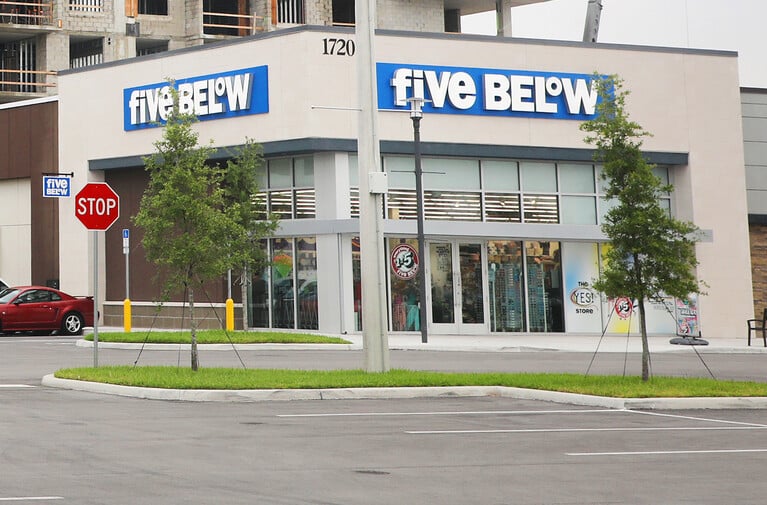
Five Below Recruits Allbirds Talent: What Brand Elevation Demands
A $6B retailer's hire of premium-brand leadership signals infrastructure shift toward sophisticated identity layers and packaging systems.
Five Below's recruitment of an Allbirds executive marks a deliberate elevation move. The retailer, valued at $6 billion and built on accessibility pricing, is widening its aperture toward brand operators who understand luxury retail identity. Allbirds manufactures sustainable footwear at premium price points—a category that demands meticulous packaging, imprinted collateral, and controlled distribution identity. Five Below's decision to import this expertise signals one thing: the company is preparing its physical and branded presence for a different class of customer and a different class of product.
This is not expansion for expansion's sake. This is infrastructure work.
What the move signals for brand architecture
Five Below has operated successfully in the $5–$25 price band with bright, accessible visual identity. Allbirds operates in $90–$150 territory. The gap between these two markets is not price alone—it is the entire system of how goods are presented, kept, and communicated to buyers. Allbirds manufactures a world where packaging imparts value. Where sourcing narratives matter. Where the unboxing experience is engineered. Five Below's hire indicates the retailer intends to produce this infrastructure internally rather than licensing or partnering. That is a significant structural commitment.
The Allbirds veteran brings more than operational knowledge. They bring the discipline of heritage-brand identity systems: seasonal color palettes, material specifications for secondary packaging, retail environmental standards, and the ability to manufacture premium collateral at scale. Five Below will need to imprint these standards across its supply chain, its store environments, and its direct-to-consumer channels.
Where the packaging and collateral layer breaks
Retailers at Five Below's scale typically outsource branded identity infrastructure to third-party vendors. They order in bulk, accept standard templates, and move inventory. Premium elevation requires the opposite: in-house product development, imprinted specifications, and buyer-side approval gates. This is where operational friction occurs. Five Below will need to establish procurement workflows for premium packaging materials. It will need to hire or contract branded identity expertise—the people who specify substrate, imprint technique, color management, and structural design. It will need to keep these systems aligned across multiple categories and price tiers simultaneously.
The window for this work is now. Competitors have not yet moved. Suppliers still have capacity. The retailer can establish standards before the market recognizes the demand.
What operators do in this window
Chief procurement officers, CMOs at heritage brands, and third-party operators should note five things immediately. First, Five Below's supply chain will expand its requests for premium packaging specifications and imprinted collateral over the next 12–18 months. Second, the retailer will test elevated visual identity in flagship markets (likely urban locations, university towns, high-income suburbs). Third, it will retain existing budget for accessible-price-tier goods while adding separate infrastructure for premium tiers—creating a two-track system. Fourth, it will require vendors who can operate at both scales without degrading quality in either. Fifth, the window to establish preferred-vendor relationships is open now, before the retailer formulates its full RFP.
Operators who have manufactured branded identity systems for mid-market brands moving upmarket understand this sequence. It is methodical. It is not rushed. Five Below's recruitment signals that the company is building the bench to move deliberately and to keep control of the identity layer as it expands. That is the way this gets handled.
Editorial & Disclosure Notice: This article was written with artificial intelligence from public sources and is published without individual human review. Artificial intelligence and other digital tools are also used for research, analysis, editing, formatting, and production. Errors, omissions, outdated information, or inaccuracies may occur. References to companies, brands, products, services, organizations, or individuals are for informational and editorial purposes and do not imply endorsement, sponsorship, affiliation, partnership, or approval unless expressly stated. All trademarks and other intellectual property remain the property of their respective owners. Opinions, analysis, estimates, and commentary are informational only and should not be construed as financial, investment, legal, tax, medical, procurement, or other professional advice. Information may be corrected, clarified, or updated after publication. Corrections or removal requests: jenny@pops4.com.