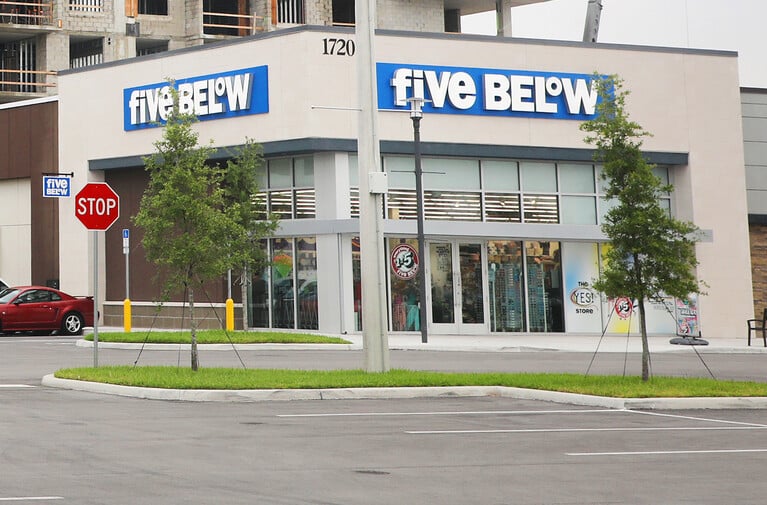
Five Below Imports Compliance Discipline via Allbirds CLO
The discount retailer's hiring of a proven legal and people officer signals a shift toward operational maturity and structural brand identity work that most competitors have not yet begun.
Five Below's appointment of Allbirds' Chief People & Legal Officer marks a deliberate move away from founder-led informality toward institutional governance. This is not a personnel shuffle. It is a signal that the company has decided to manufacture operational discipline at scale—the kind that protects margin, limits liability, and, critically, sets the stage for branded identity infrastructure that can travel across 1,400+ physical locations without fracture.
What the move signals operationally
Allbirds built its reputation on supply-chain transparency and material ethics. Their CLO did not simply manage legal exposure; she enforced brand coherence from warehouse to storefront. Five Below operates in a tier where discretionary spending remains volatile. A Chief People & Legal Officer from a heritage brand signals one clear intent: the company is moving toward the kind of standardized systems that allow regional variation without brand erosion. That person brings frameworks. Frameworks keep identity imprinted consistently across owned and operated channels.
This hiring also telegraphs that Five Below expects regulatory scrutiny to increase. Discount retail sits at the intersection of labor compliance, consumer protection, and supply accountability. The move preempts pressure by installing someone credible. Heritage houses and family offices note this dynamic: when boards hire compliance-first leadership from mission-driven brands, they are preparing for the next operating environment, not solving today's problem.
Where branded identity infrastructure becomes critical
Five Below's physical footprint grows faster than its cultural coherence can naturally keep pace. A CLO from Allbirds knows this problem intimately. She will architect the systems required to ensure that a store in Raleigh, a warehouse in Las Vegas, and a distribution hub in New Jersey all manufacture the same customer experience—same service standards, same visual language, same implied promise.
This is where most discount retailers fail. They expand merchandise and locations before they imprint operational identity. Five Below is installing governance first. That creates a window for branded objects, point-of-sale systems, staff uniforms, packaging materials, and environmental design to be conceived as an integrated system rather than as afterthoughts. The company will need partners who understand that distinction—who can architect house-imprinted work that work within tight margin structures and do not require recertification every eighteen months.
What operators do in this window
For premium sales teams, CMOs at heritage houses, and event planners working with multi-location clients, this hiring is an early indicator. It means Five Below is beginning to formalize procurement standards. Regional autonomy will tighten. Approval cycles will lengthen. Volume commitments will matter more than relationship depth. The window to establish preferred-vendor relationships is now, before standardization locks in competitors.
For single-family offices and principals evaluating retail investments, the signal is clearer still: Five Below is building toward institutional durability. The company is not seeking explosive growth; it is seeking sustainable architecture. That changes the risk profile of partnerships, supply contracts, and location decisions.
When a discount retailer hires a CLO from a brand known for ethical supply-chain work, it is also signaling that private-label development and exclusive partnerships are coming. Branded identity infrastructure—the physical and systemic assets that differentiate one retailer from another—becomes the competitive asset, not price. The way this gets handled determines whether Five Below becomes a platform that operators build within, or a standard vendor they work around.
Editorial & Disclosure Notice: This article was written with artificial intelligence from public sources and is published without individual human review. Artificial intelligence and other digital tools are also used for research, analysis, editing, formatting, and production. Errors, omissions, outdated information, or inaccuracies may occur. References to companies, brands, products, services, organizations, or individuals are for informational and editorial purposes and do not imply endorsement, sponsorship, affiliation, partnership, or approval unless expressly stated. All trademarks and other intellectual property remain the property of their respective owners. Opinions, analysis, estimates, and commentary are informational only and should not be construed as financial, investment, legal, tax, medical, procurement, or other professional advice. Information may be corrected, clarified, or updated after publication. Corrections or removal requests: jenny@pops4.com.