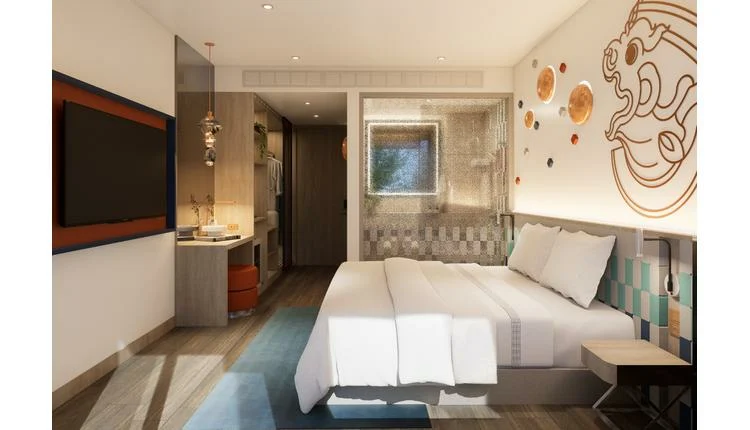
IHG Krabi Expansion Signals Premium Identity Reboot
Holiday Inn Express Thailand launch requires calibrated guest amenity infrastructure and opening-event branded architecture across 18 months.
IHG Hotels & Resorts is moving forward on Holiday Inn Express Krabi—a new-build property in southern Thailand designed to anchor the group's regional presence and capture the upper-middle leisure segment. This is not a retrofit. This is a platform build. The property opens a deliberate window for branded identity infrastructure to establish itself before guest arrival, and it signals the group's intention to manufacture prestige at the arrival and departure moment across Asia-Pacific tier-two markets.
What matters here: IHG is moving away from generic welcome packets. The Krabi opening requires calibrated guest amenities, opening-event packaging, and logistical objects that imprint identity at three specific moments—pre-arrival communication, room entry, and departure. This is infrastructure work. It takes 14-18 months to source, produce, and stage correctly across a single property launch in a new market.
What the Krabi Play Signals
IHG's Thailand expansion is not growth noise. It is positioning. The company is competing directly against Accor and Marriott in a market where premium leisure guests expect tactile, imprinted experiences at the property level. Holiday Inn Express Krabi will operate as a flagship test case. Success here unlocks 4-6 additional properties across the region in the next 24 months. That means branded identity infrastructure must be built at scale now—not retrofitted later.
The signal is precise: regional premium hotels now require house-imprinted objects and welcome systems that read as intentional, locally considered, and operationally reliable. Generic does not hold. Krabi will be measured by how the brand is kept across every guest touchpoint—luggage tag systems, amenity packaging, opening-event collateral, staff uniforms, arrival materials, wayfinding. Each piece must speak the same dialect.
Where the Identity Layer Breaks
Most hotel launches fail at one critical juncture: they manufacture the opening event—the ribbon cutting, the press kit, the VIP dinner—but they do not build the infrastructure that keeps the brand intact for the first 500 guests through month three. That gap is where most launches lose coherence.
Krabi requires a different approach. The opening event is secondary. The primary infrastructure is the system that ensures every guest departure creates the same brand impression as arrival. That means amenity packaging is sourced from a single factory, approved under unified standards, and imprinted with consistency. Staff materials are produced from a single house, not assembled from five vendors. Collateral moves through one quality gate. This is the discipline that prevents brand decay in months 2-8.
What Operators Do in This Window
Experienced operators—VP Premium Sales, heritage-house CMOs, event planners working at this tier—begin procurement conversations now. Not in month eight. Now. The lead time for sourcing and producing house-imprinted guest amenities across Asia-Pacific is 16-20 weeks minimum. Opening-event infrastructure requires 12-14 weeks. Samples require 6 weeks. That leaves a 4-week approval window. Miss this window, and the property opens with generic amenities and scattered event materials.
The move also signals that Single Family Office principals and their Chiefs of Staff should be reviewing their own hospitality asset holdings. If you hold premium hospitality across emerging markets, this Krabi moment tells you something: branded identity infrastructure is now table stakes for asset differentiation and guest retention. Properties that keep their brand intact across the first year outrank those that do not. The way this gets handled—sourcing, production, quality control, installation—determines whether that property becomes a platform for regional growth or stalls at opening momentum.
Editorial & Disclosure Notice: This article was written with artificial intelligence from public sources and is published without individual human review. Artificial intelligence and other digital tools are also used for research, analysis, editing, formatting, and production. Errors, omissions, outdated information, or inaccuracies may occur. References to companies, brands, products, services, organizations, or individuals are for informational and editorial purposes and do not imply endorsement, sponsorship, affiliation, partnership, or approval unless expressly stated. All trademarks and other intellectual property remain the property of their respective owners. Opinions, analysis, estimates, and commentary are informational only and should not be construed as financial, investment, legal, tax, medical, procurement, or other professional advice. Information may be corrected, clarified, or updated after publication. Corrections or removal requests: jenny@pops4.com.