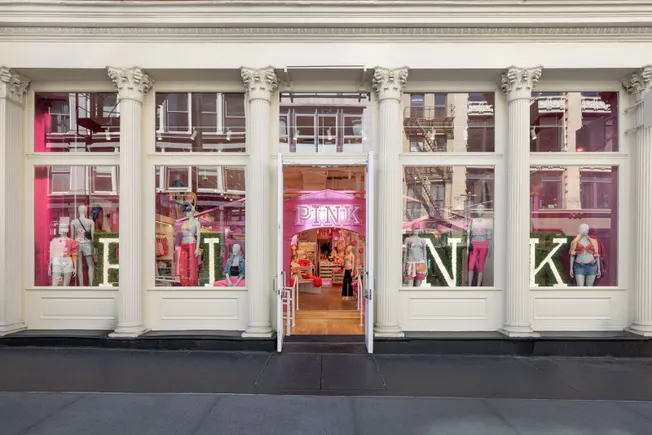
Victoria's Secret Anchors PINK Subbrand With Anthropologie CMO
CEO Hillary Super's executive hire signals structural reinvestment in the independent merchandising identity that once displaced mid-market retail.
Victoria's Secret & Co. appointed a Chief Merchandising Officer to the PINK subbrand this week—a move that carries weight beyond standard executive circulation. The hire comes from Anthropologie, the Williams-Sonoma-owned heritage retailer known for keeping distinct visual identity through merchandising discipline. CEO Hillary Super made the announcement herself, which matters. This is not a backfill. This is recommitment.
PINK launched in 1996 as Victoria's Secret's youth-facing subdivision. By the early 2010s it held standalone locations and drove traffic that rivaled the parent brand. Then the architecture collapsed. Store counts contracted. The identity layer—visual merchandising, product adjacency, customer experience design—flattened into parent-brand logic. What once displaced competitors became absorbed by them.
The Anthropologie hire reframes PINK as a separate merchandising operation, not a sub-category housed in parent locations. That distinction is operational. It requires separate buying calendars, distinct vendor relationships, independent visual direction, and imprinted brand objects that carry PINK identity, not Victoria's Secret identity wearing PINK packaging.
What the structural signal means
This move indicates Victoria's Secret has absorbed the cost of the brand architecture collapse and is now building backwards into separation. Anthropologie operates under a different merchandising logic than Victoria's Secret. Anthropologie manufactures discovery through curation, adjacency, and visual narrative. Victoria's Secret manufactures velocity through category dominance and inventory density. These are incompatible when housed in the same space.
The new CMO hire suggests the company will fund separate merchandising teams, separate sourcing, separate branded identity infrastructure—everything from shopping bags to store fixtures to the visual language of digital presentation. This requires capital. It requires accepting lower per-square-foot productivity in the rebuild phase. Single Family Office principals and their advisors should note: this is a bet on margin recovery three to five years ahead, not immediate revenue lift.
Where the identity layer breaks down most visibly
In current PINK locations, the branded objects—bags, boxes, tissue, hangtags, signage systems—carry parent-brand geometry and color hierarchy. A customer moves from PINK product to PINK checkout to PINK packaging, but sees Victoria's Secret imprinting at every transaction point. That compression erodes the visual separation that made PINK distinct in market memory.
The Anthropologie operational model keeps merchandising identity separate from parent-company systems. Anthropologie does not manufacture bags for Williams-Sonoma. It imprints objects with its own narrative. A PINK rebuild under this same discipline means procurement of wholly separate branded identity infrastructure: packaging, fixtures, digital assets, signage systems, even the paper stock in receipts. These objects anchor the brand in customer memory. Without them, PINK remains a pricing tier, not a place.
What operators and chiefs of staff do in this window
Experienced CMOs and VP Premium Sales watch the rollout of PINK's first 12 months under new merchandising direction. The early signals come through three channels: vendor announcement cycles, store refresh schedules, and branded object design releases. Operators should track which new vendors enter PINK's buying committee. They should note the timing of store renovations—PINK locations receiving new fixtures before fall 2024 indicate capital commitment. They should document the visual language of early PINK branded objects.
Event planners and principals building sponsorship strategy should recognize that PINK's recommitment creates a newly coherent brand partner. A fragmented PINK cannot anchor an event experience. A PINK that has rebuilt its merchandising identity and imprinted its objects with distinct narrative becomes a premium activation platform. This is 18 months away. The window to position ahead of that maturation opens now.
Editorial & Disclosure Notice: This article was written with artificial intelligence from public sources and is published without individual human review. Artificial intelligence and other digital tools are also used for research, analysis, editing, formatting, and production. Errors, omissions, outdated information, or inaccuracies may occur. References to companies, brands, products, services, organizations, or individuals are for informational and editorial purposes and do not imply endorsement, sponsorship, affiliation, partnership, or approval unless expressly stated. All trademarks and other intellectual property remain the property of their respective owners. Opinions, analysis, estimates, and commentary are informational only and should not be construed as financial, investment, legal, tax, medical, procurement, or other professional advice. Information may be corrected, clarified, or updated after publication. Corrections or removal requests: jenny@pops4.com.