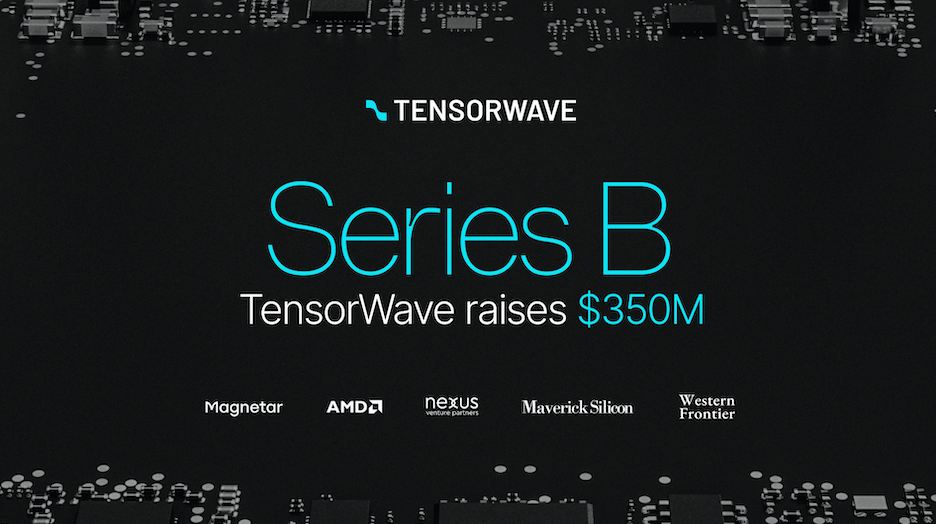
TensorWave's $350M Series C: When Infrastructure Demands Presence
A data center competitor raises capital to displace Nvidia's dominance—and now manufactures a visibility problem that branded identity infrastructure must solve.
TensorWave closed $350M in Series C funding this week to manufacture and deploy AI chip infrastructure that outranks Nvidia's current market hold. The capital deployment signals something clearer than the engineering roadmap: a company moving from lab-stage credibility into enterprise sales where procurement committees, C-suites, and board advisors make decisions in rooms where presence matters. The funding itself is the news. What follows—identity, imprint, proximity—is the infrastructure that sustains it.
What the capital shift signals for brand architecture
Series C is the moment a company stops being a technical claim and becomes a counterweight. TensorWave now competes not just on specs but on who knows them, who remembers the name, and who keeps their collateral on the desk when the RFP window opens. A $350M raise manufactures demand for physical brand presence—the objects and materials that land in the hands of the people who write the checks. The company's engineers built the chip. Now someone must build the identity infrastructure that makes procurement committees note the alternative.
This is the tier where heritage enterprises and single-family offices making infrastructure bets need clarity. TensorWave moves into a sales cycle where every stakeholder touchpoint—from executive briefing materials to data center site materials to partnership announcements—imprints the message that this is not a startup; this is the counterweight. That imprint is manufactured. It is not accident.
Where the identity layer breaks for most competitors
Most companies in this position default to the playbook: website refresh, sales deck redesign, press release template. They treat branding as finish work. TensorWave's window—the next 18 months of field sales, strategic partnerships, and customer acquisition—demands something architectural. The company needs house-imprinted materials that displace perception. Not materials that announce. Materials that imprint authority.
This means three things most operators miss. First: the collateral that lands in a procurement officer's hands must signal counterweight status before the pitch begins. Second: partnership and co-branding materials must keep the message consistent across every stakeholder organization in the supply chain. Third: the materials themselves—weight of paper, precision of imprint, discipline of design—must manufacture credibility at the object level.
Heritage houses and single-family office advisors overseeing infrastructure or tech bets watch for this moment. When a company raises this tier of capital and the identity layer lags, the funding acceleration stalls in sales cycles. The better the branded identity infrastructure, the faster capital converts to contracts.
What operators do in this 18-month window
The operational play is narrow and timed. TensorWave has approximately 18 months before the next capital event or public inflection. In that window, every customer acquisition, every partnership announcement, every board presentation must carry architecture. The company that manufactures a coherent identity infrastructure outpaces the company that manufactures good slides.
For operators managing this tier of client—VPs of Premium Sales, CMOs at heritage houses, event planners at the $250K+ tier—the work is structural. You identify where the identity layer breaks. You manufacture materials that keep the message consistent across every stakeholder. You imprint authority into the physical objects that sit on desks when the decision gets made. You do this with discipline. You do not add noise.
This is the way this gets handled—not through volume of materials, but through precision of imprint, and through the discipline to keep every object in service of the single message: this company displaces the alternative.
Editorial & Disclosure Notice: This article was written with artificial intelligence from public sources and is published without individual human review. Artificial intelligence and other digital tools are also used for research, analysis, editing, formatting, and production. Errors, omissions, outdated information, or inaccuracies may occur. References to companies, brands, products, services, organizations, or individuals are for informational and editorial purposes and do not imply endorsement, sponsorship, affiliation, partnership, or approval unless expressly stated. All trademarks and other intellectual property remain the property of their respective owners. Opinions, analysis, estimates, and commentary are informational only and should not be construed as financial, investment, legal, tax, medical, procurement, or other professional advice. Information may be corrected, clarified, or updated after publication. Corrections or removal requests: jenny@pops4.com.