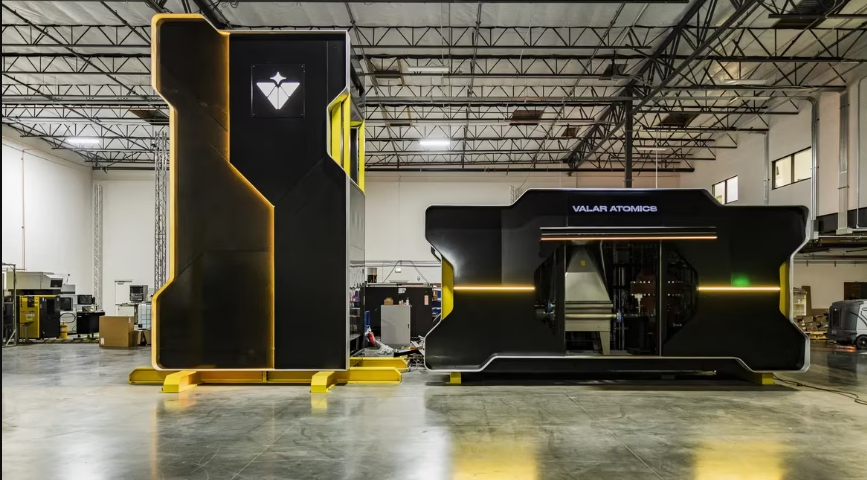
Valar Atomics Scales: The Identity Infrastructure Window Opens
Post-$1B funding, the nuclear reactor manufacturer now manufactures its own institutional presence—and principals, partners, and clients will expect to see it.
Valar Atomics closed a $1 billion Series C round to move small modular reactors from prototype to production. The company supplies power systems to data centers and AI infrastructure operators. This is not venture theater. It is the moment a hard-asset manufacturer becomes a principal counterparty in supply-chain negotiations, board introductions, and partnership ceremonies. Everything that moves across a table—from the printed executive summary to the client portfolio case, from the investor briefing book to the conference collateral—now carries institutional weight it did not carry twelve months ago.
When a company reaches this scale, branded identity infrastructure ceases to be discretionary. It becomes the physical grammar of how deals get done.
What the move signals for institutional presence
Valar shifts from engineering-led to relationship-managed. A billion dollars in capital does not secure supply contracts or lock in partnership terms. A principal does. That principal—whether CEO, COO, or board chair—now enters rooms where every object imprinted with the company mark becomes a measure of operational discipline and stability. Paper stock matters. Binding method matters. The color palette on a pitch deck matters, because consistency reads as control.
The company will open a business development function. It will hire institutional sales leadership. It will conduct roadshows for investor updates, supplier negotiations, and client on-boarding. None of these activities succeed with borrowed collateral or generic templates. The manufacturing timeline is fixed; the partnership timeline is not. Valar manufactures reactors on schedule. It manufactures confidence through kept visual standards.
Where the identity layer displaces prior structure
A venture-stage or Series B company manufactures technical credibility. Charts, spec sheets, certification documents. Valar already owns those. What Valar manufactures now is institutional durability. A partner in a ten-year reactor supply agreement does not make that commitment to a company that looks improvised. They make it to a company that keeps margins, typefaces, material finishes, and production timelines.
The window to establish that infrastructure is narrow. Sixty to ninety days. After that, Valar enters market conversations with whatever collateral it has in hand. If that collateral was produced on an ad-hoc basis—if binding methods change, if paper stocks vary, if the executive portfolio looks assembled rather than imprinted—the company reads as younger than its capital base suggests. Worse: a potential partner begins to calculate operational risk by observing how seriously Valar manufactures its own representation.
What experienced operators do in this window
A Chief of Staff or VP Premium Sales at a heritage house does three things now. First: audit the current collateral ecosystem. What exists. What state it is in. What gets produced in-house and what gets farmed out. Second: establish production specifications and vendor partnerships for the next twenty-four months of growth—not the next six. That includes the objects principals hand across tables: executive presentations, capability summaries, deal books, event signage, client welcome packages, board materials. Third: brief the executive team on what institutional collateral means in supply-chain negotiations. A potential reactor customer notices when a Valar executive hands them a presentation that is produced with the same discipline that produces the reactor itself.
The way this gets handled—the way a company manufactures confidence at scale—is not rushed. It is not improvised. It is kept to the standard that the product itself has already established.
Editorial & Disclosure Notice: This article was written with artificial intelligence from public sources and is published without individual human review. Artificial intelligence and other digital tools are also used for research, analysis, editing, formatting, and production. Errors, omissions, outdated information, or inaccuracies may occur. References to companies, brands, products, services, organizations, or individuals are for informational and editorial purposes and do not imply endorsement, sponsorship, affiliation, partnership, or approval unless expressly stated. All trademarks and other intellectual property remain the property of their respective owners. Opinions, analysis, estimates, and commentary are informational only and should not be construed as financial, investment, legal, tax, medical, procurement, or other professional advice. Information may be corrected, clarified, or updated after publication. Corrections or removal requests: jenny@pops4.com.