The Trillion-Dollar Table - Corporate Gifting Crosses From Expense to Infrastructure
A $956.93 billion market moving toward $1.31 trillion by 2030 - and the measured evidence that the right physical piece, carrying the client's own mark, at the right time, is the quietest revenue instrument in B2B.
Most operators still book branded goods as a giveaway line. The market has stopped agreeing with them.
A trillion-dollar table.
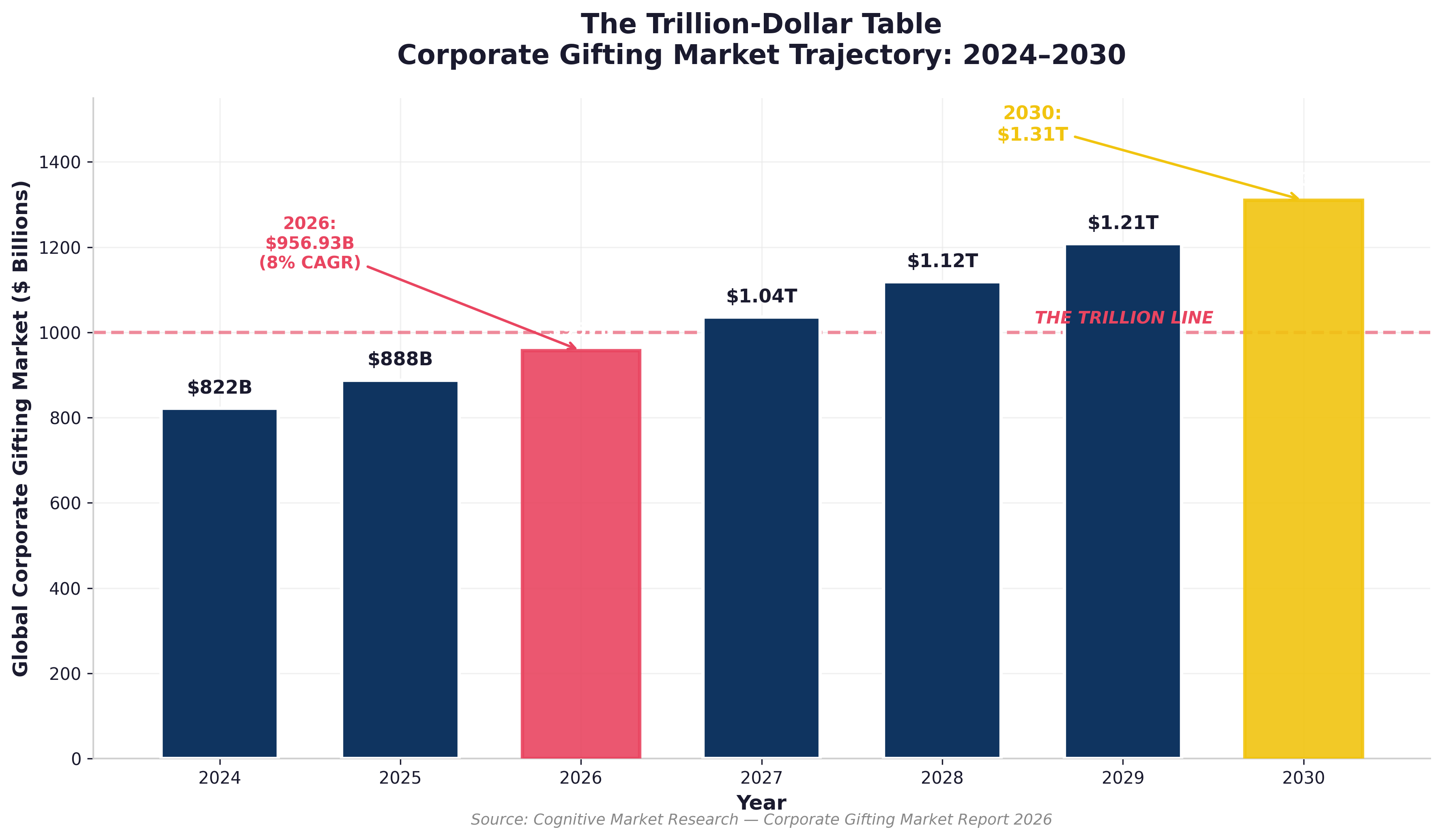
Corporate gifting stands at 956.93 billion dollars in 2026, growing near eight percent a year toward 1.31 trillion by 2030. The United States business-to-business share alone approaches 312 billion dollars. This is not a promotional budget. It is infrastructure for standing - and the houses that treat it that way are taking the measurable results.
The published trajectory: 956.93 billion dollars in 2026, growing near eight percent a year to 1.31 trillion by 2030. Source: Cognitive Market Research.
In the same week this release was filed, UBS published its Global Wealth Report 2026: America minted more than 440,000 new millionaires in 2025 - a pace above 1,200 per day - bringing the US total to 23.6 million, over forty percent of the world's 57.5 million. Median wealth fell across most tracked countries while the averages climbed. The population that buys considered, standing-signal goods now compounds daily; the population that buys on price is thinning.
The conversion record.
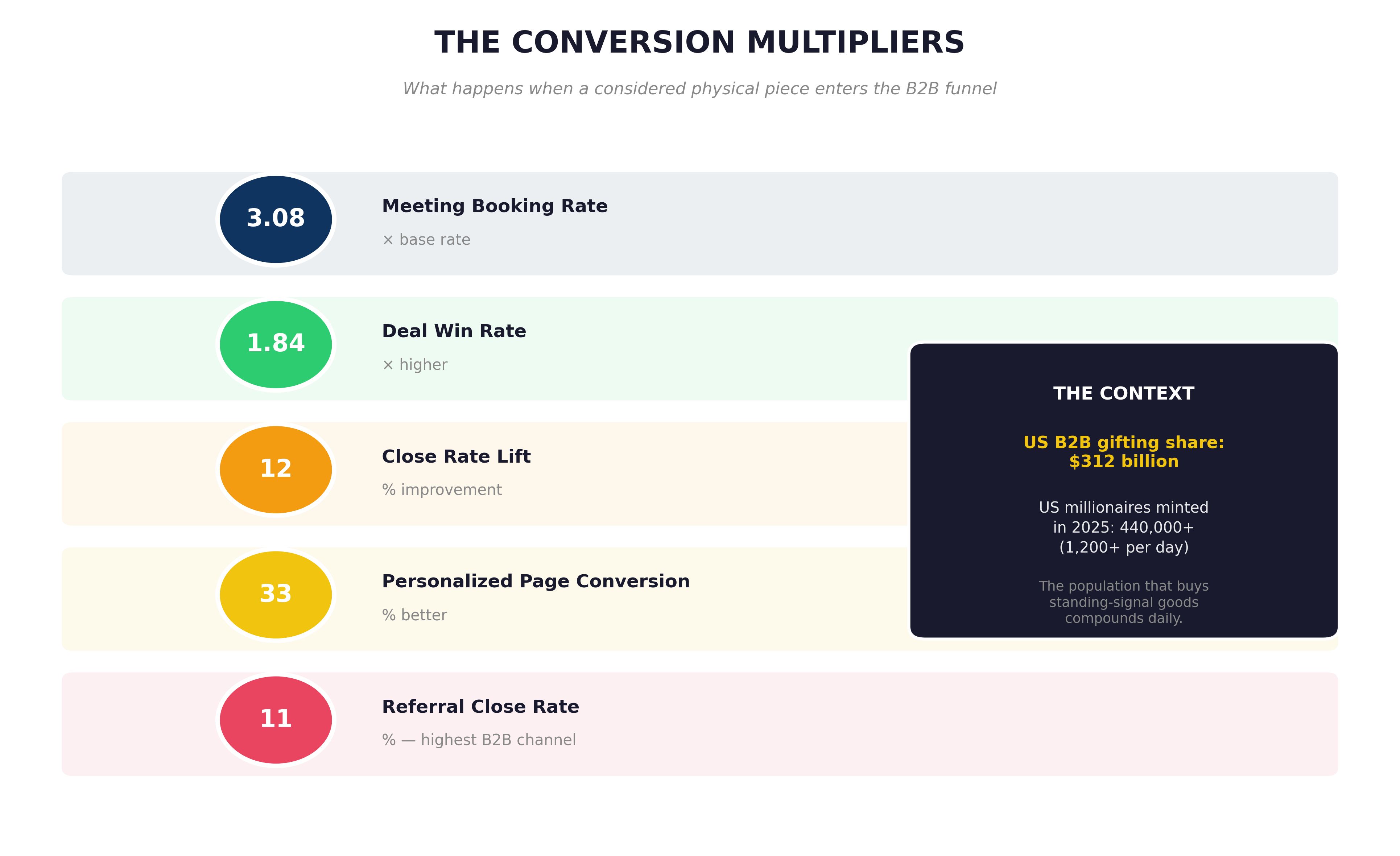
The category's conversion record, drawn from published 2026 research: outreach that includes a considered gift books meetings at 3.08 times the base rate. Deals opened with a gifting touchpoint close at a 1.84 times higher win rate. A promised closing gift lifts business-to-business close rates 12 percent. A page personalized to the recipient - their own brand already on real pieces - converts 33 percent better than a catalog. A five percent improvement in client retention raises profit 25 to 95 percent. And referred introductions close at roughly 11 percent - the highest rate of any business-to-business channel.
Every figure here is the published 2026 research quoted above, against a US business-to-business gifting share of 312 billion dollars.
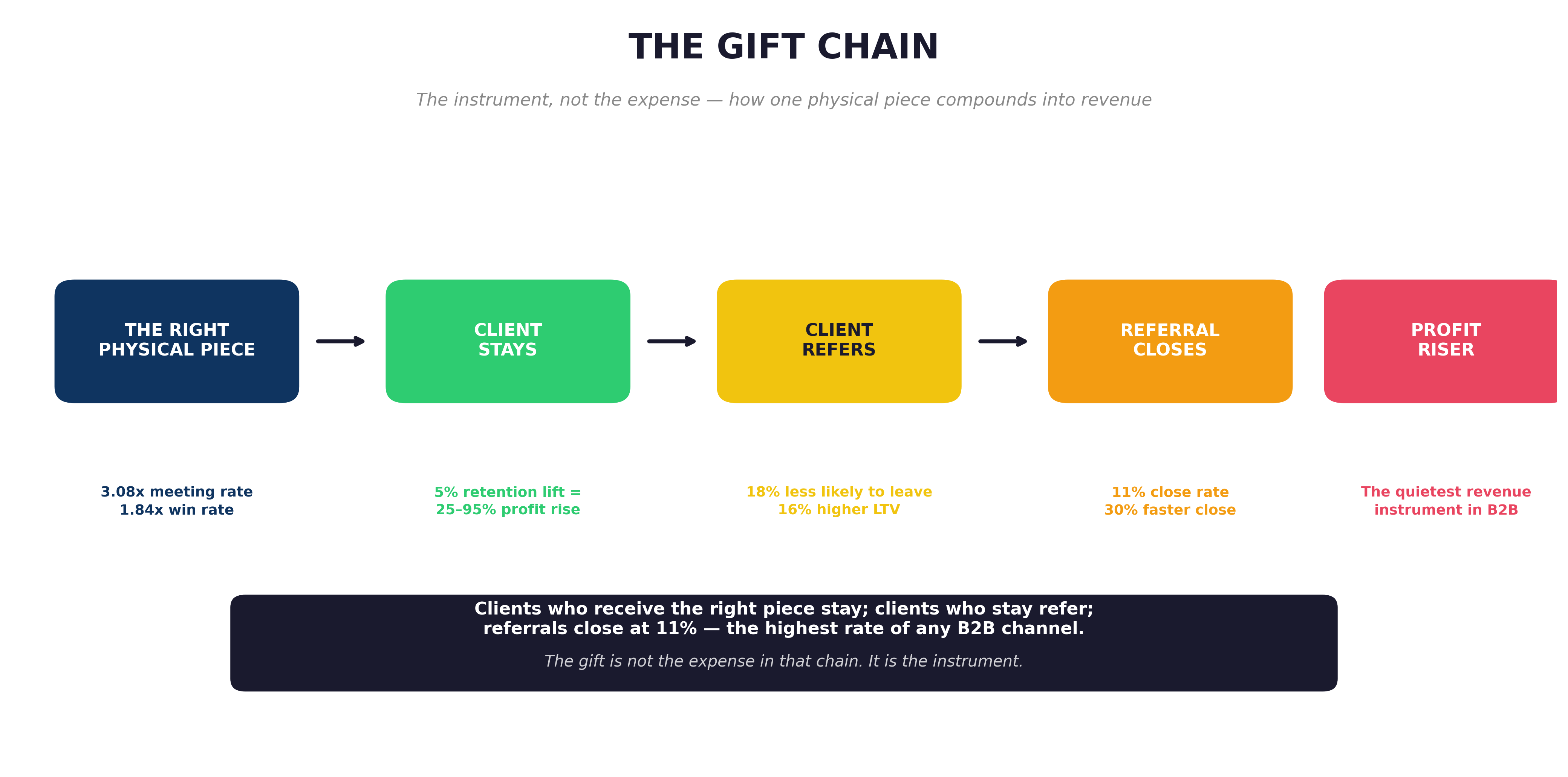
Read together, the chain is plain: clients who receive the right physical piece stay, clients who stay refer, and referrals close at a rate no advertising channel approaches. The gift is not the expense in that chain. It is the instrument.
The house position.
Huang Goodman and its manufacturing house, Hako Shikin LLC, have operated on that chain since 1997: two hundred and more authorized luxury houses, fourteen hundred and more US manufacturers held to Six Sigma standard, blind-shipped and confidential by contract, from single white-glove placements to full-truckload programs. The house measures its reward the way its clients do - the client's own mark, on the right physical piece, in the right hands, at the right moment. Orders pay the house. What rewards it is what walks back through the door afterward: a client whose brand looked right when it mattered, telling someone else.
The referral ledger, verified.
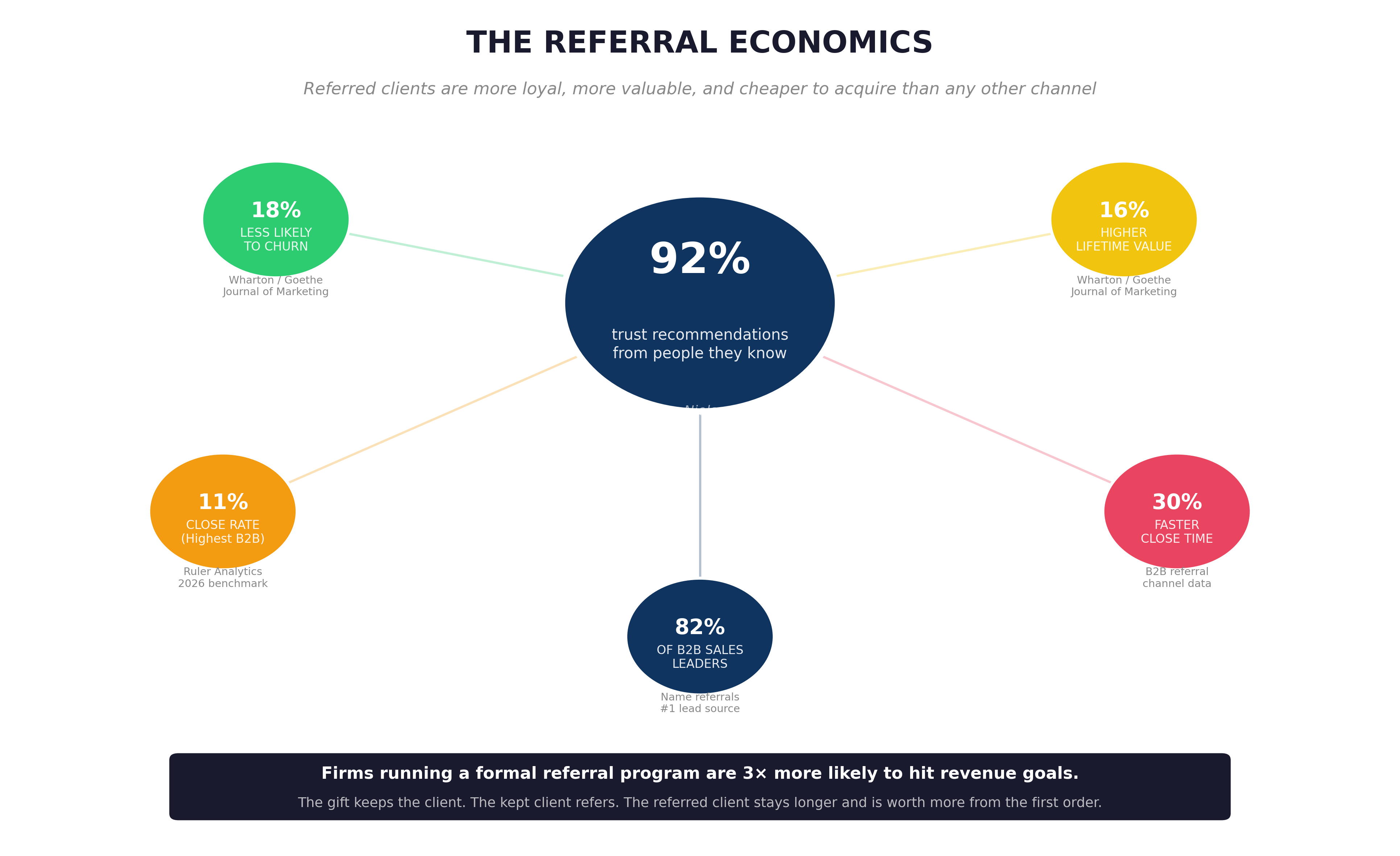
The academic anchor is a peer-reviewed Journal of Marketing study run by Wharton and Goethe University across nearly 10,000 bank customers: referred clients were 18 percent less likely to leave and carried a 16 percent higher lifetime value than clients acquired any other way - loyalty and value, measured, not asserted. Nielsen puts the reason plainly: 92 percent of people trust a recommendation from someone they know, the most credible channel advertising money cannot buy.
The Wharton and Goethe study across nearly 10,000 bank customers, with the Nielsen trust figure and the 2026 channel benchmarks.
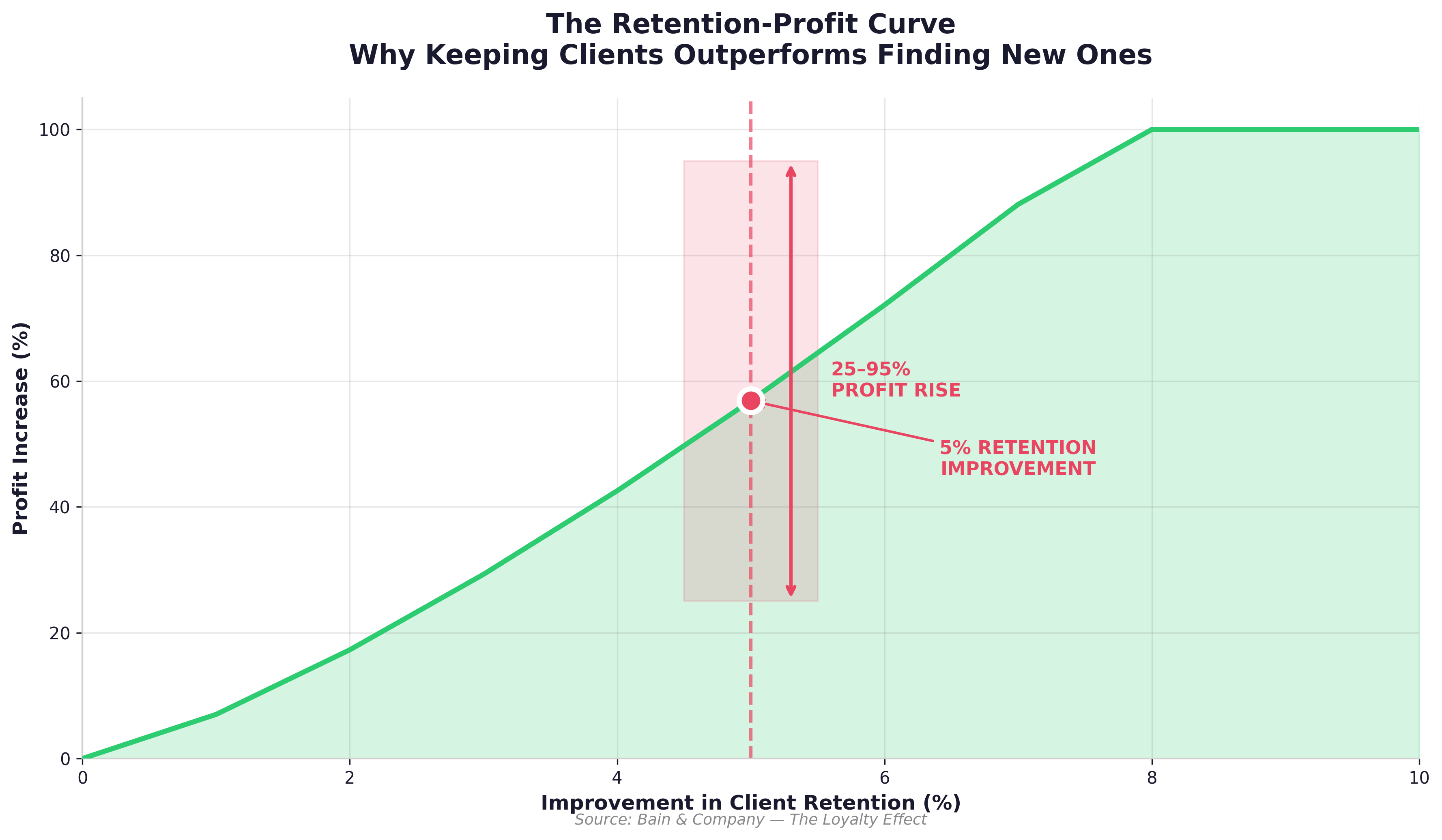
The business-to-business record matches. Referred introductions close at roughly 11 percent - the top of every 2026 channel benchmark - and close about 30 percent faster. 82 percent of B2B sales leaders name referrals their best source of leads, and firms running a formal referral program are 3 times more likely to hit their revenue goals. Underneath all of it sits the retention math Bain and Company established: hold 5 percent more clients and profit rises 25 to 95 percent.
Bain and Company: hold five percent more clients and profit rises 25 to 95 percent. This is the arithmetic underneath the whole chain.
Why the gift is an instrument.
This is why the house treats the gift as an instrument. The right piece keeps the client; the kept client refers; the referred client stays longer and is worth more from the first order. Every number in that chain is published.
The chain in one view. The client who receives the right piece stays, the kept client refers, and the referred introduction closes at the highest rate in business-to-business.
The steal: stop grading the gift line as an expense. Price it as the standing it confers, measure it by who returns and who they bring, and put the recipient's own brand on the page before they arrive - the 33 percent is waiting there.
The myth this ends: branded goods are a giveaway line item. It is a trillion-dollar trust instrument, and the record above is how it pays.
Clients who receive the right piece stay; clients who stay refer; referrals close at 11 percent. The gift is the instrument, not the expense.
Editorial & Disclosure Notice: This article was written with artificial intelligence from public sources and is published without individual human review. Artificial intelligence and other digital tools are also used for research, analysis, editing, formatting, and production. Errors, omissions, outdated information, or inaccuracies may occur. References to companies, brands, products, services, organizations, or individuals are for informational and editorial purposes and do not imply endorsement, sponsorship, affiliation, partnership, or approval unless expressly stated. All trademarks and other intellectual property remain the property of their respective owners. Opinions, analysis, estimates, and commentary are informational only and should not be construed as financial, investment, legal, tax, medical, procurement, or other professional advice. Information may be corrected, clarified, or updated after publication. Corrections or removal requests: jenny@pops4.com.
Steal this — paste into your AI
Paste into your AI: My company serves [category]. Corporate gifting is a $956.93B market growing to $1.31T by 2030; gift-led outreach books 3.08x meetings and 1.84x win rates; referred introductions close at 11 percent. Map my top ten client relationships to the trigger moments where a considered physical piece would be received as standing rather than marketing, and rank them by referral likelihood.
The branded-identity layer Chiefs of Staff and heritage CMOs route through — your name imprinted on real authorized stock, your pick of 200+ brands and 70,000 products, shipped from one accountable house. Nine editorial desks publish the intelligence those operators read before they sign.
200+authorized brands
70,000products · virtual proof on each
9 deskspublishing daily
1997one house, since
70,000 SKUs · virtual proof in 60 seconds · no platform fee · blind-shipped · ASI #217876
Your next customer won't visit your website. Their AI will.
AI assistants have quietly taken over the first step of buying — they answer from catalogs they can read and shortlist whoever can actually ship. Two questions now decide whether you exist to that buyer: can a machine read your catalog, and can you fulfill the order. Most brands fail one or both and never find out why the orders went elsewhere. The winners of this shift aren't the loudest. They're the most readable. Build for the machine that's about to do the shopping.
Built by the craft floor — apparel, media, packaging, and secure print.
This trade runs on hands, not desks. Imprint manufacturing & Komori heritage press through approved vendors · Canon high-speed secure-media operations is a craft floor — genuine Six Sigma discipline applied to ink, thread, foil, and registration, where a hundredth of an inch is the difference between a brand that reads serious and one that reads cheap. POPS4 is built by exactly those operators: independent, boots-on-the-ground engineers who carry their own book, read a client in microseconds, and put their name on every run. Beyond our own Virginia Beach floor, we work with a vetted network of craft manufacturers across the US — each meeting the highest excellence in QC standards in the industry, each a specialist in its own discipline — so apparel, hard-goods imprinting, media manufacturing, packaging, and secure printing all go to the bench built for them, coordinated from one accountable hub. Short-run from twenty-five units, volume to five hundred thousand. Two hundred authorized national brands, seventy thousand SKUs with virtual proofing on every one. Art archived for instant reorders. Net-thirty corporate terms, NDA-standard white-label — your name on the work, or none at all.
Strategy, positioning, identity, creative, and messaging — wired into an AI system that publishes and distributes on its own. Nine editorial desks generate the authority, the production house ships the physical proof, and the attribution layer tells you which post sold which SKU. What you get is an operating layer — content, catalog, and order path under one roof — that keeps working whether or not you are in the room. Built for principals who would rather own the machine than rent the agency.
Named-account programs — one desk, quiet delivery, NDA-standard.
One point of contact who already knows the file, so nothing restarts from zero between engagements. The work ships blind, under NDA, with your name on it or none at all. Built for single-family offices, heritage-house CMOs, sports-ownership groups, and the agencies that white-label our production. The relationship is the product; the merch is the proof of it.
SFO · Chief of Staff desk. Principal household, properties, aircraft, yacht, calendar, philanthropy — one file.
Shop seventy thousand products. Virtual proof on every one. 24/7.
Drop your logo on any product and see the virtual proof before asking. Quote routes direct to the desk. MCP catalog for AI agents. Celeste for the fast conversation. Full self-service checkout in development.